
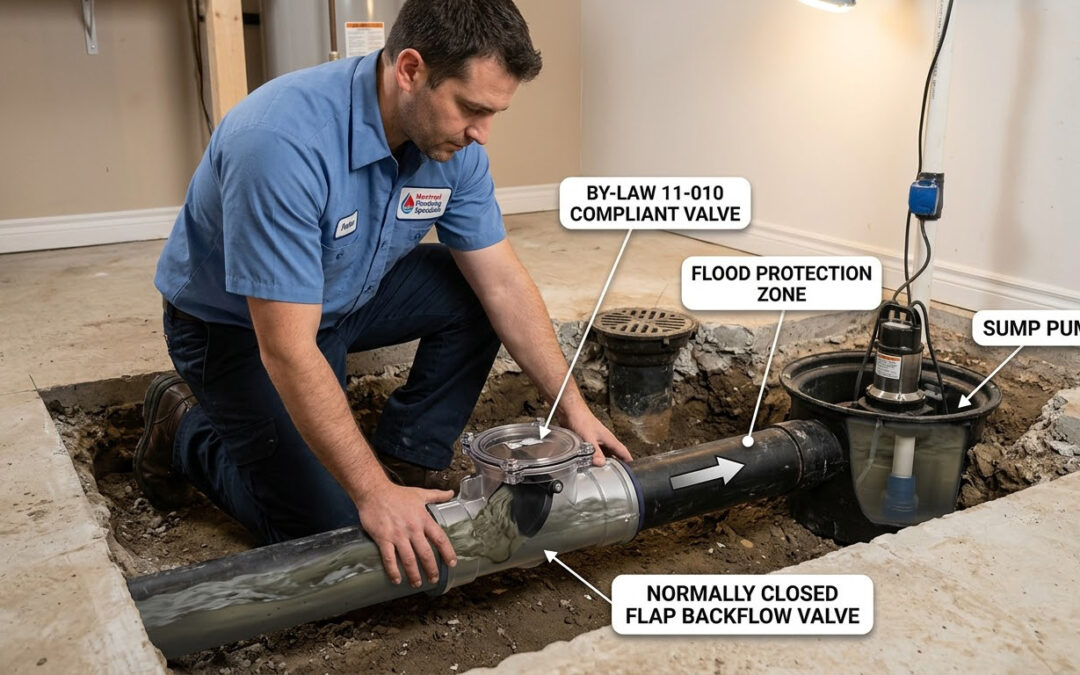
Backflow Valve Installation Montreal: By-Laws, Costs & Flood Protection
Key Takeaway
Montreal’s By-Law 11-010 requires a backflow preventer on every drain pipe serving fixtures below street level. Since 2011, all new buildings must have them. Installation costs $750 – $2,500 depending on accessibility, and the City of Montreal’s RénoPlex program offers subsidies for eligible homeowners. A single sewer backup without protection can cause $10,000 – $50,000+ in damage. The valve costs a fraction of that.
If your basement has a toilet, shower, laundry, or floor drain and no backflow valve, you are one heavy rainstorm away from a sewage flood.
A backflow preventer (also called a backwater valve, check valve, or clapet antiretour in French) is your basement’s last line of defence against sewer backup. When Montreal’s combined sewer system gets overwhelmed during heavy rain or rapid snowmelt, sewage can reverse direction and flood your home through floor drains, toilets, and laundry connections. A properly installed backflow valve stops that from happening.
This guide covers everything Montreal homeowners need to know: the municipal by-laws that make installation mandatory, current costs and available subsidies, the different valve types, the installation process, maintenance requirements, and how a backflow preventer works alongside other sewer backup prevention Montreal measures to keep your basement dry.
Montreal By-Laws: Is a Backflow Valve Mandatory?
Yes. The City of Montreal’s By-Law 11-010 (concerning protection of buildings against sewer backup) is clear:
Requirement 1: A backflow preventer must be installed on every drainage pipe connected to a building drain that serves a sanitary appliance located beneath the adjacent street level. This includes basement toilets, sinks, showers, washing machines, and floor drains.
Requirement 2: Since 2011, all new buildings in Montreal must include backflow valves as part of the original plumbing installation.
Requirement 3: If your property has experienced a sewer backup or flooding, installing a backflow valve on each affected fixture or group of fixtures is mandatory.
Requirement 4: The valve must be installed downstream from the trap seal of a floor drain. Where several fixtures share the same drain connection, a single valve may protect the group.
Beyond Montreal’s municipal by-law, the Quebec Construction Code and the National Plumbing Code of Canada both require backflow protection for below-grade plumbing. The Régie du bâtiment du Québec (RBQ) enforces construction code compliance across the province, and the CMMTQ licenses plumbers who perform the work.
Insurance implications: Many Quebec insurers now require a functioning backflow preventer as a condition for sewer backup coverage. Without one, your claim may be denied. Some insurers have begun refusing the “Water Damage – Groundwater and Sewer” endorsement entirely for buildings without compliant valves. Installing one protects both your home and your insurance coverage.
Types of Backflow Valves Explained
Not all backflow preventer valves work the same way. The right type depends on your plumbing configuration, local code requirements, and water table conditions. Here are the main types used in Montreal homes:
Normally Closed Valve
The flap stays closed and only opens when wastewater flows out. Provides a continuous seal against both sewer backup and groundwater infiltration. Most common in Montreal residential installations.
Best for: Basement floor drains, laundry sinks, individual fixtures
Normally Open Valve
The flap stays open during normal flow and only closes when backflow pressure is detected. Allows free air circulation for venting. Used on main building drains where venting must not be obstructed.
Best for: Main drain lines, single-family homes
Flap (Swing-Check) Valve
Uses a hinged flap that swings open with outgoing flow and closes under backflow pressure. Simple, reliable, and relatively affordable. Effective even with low-pressure differential.
Best for: General residential use, cost-effective protection
Gate Valve (Manual Override)
A manual or semi-automatic valve with a sliding gate mechanism. Some models include an electronic sensor that inflates a balloon to block backflow and deflates when safe. Highest level of control but requires more maintenance.
Best for: Main conduits, properties with repeated flooding history
Important: In Quebec, it is prohibited to install a normally closed backflow valve on the main drainage line because it would block air circulation needed for proper drain venting. Normally closed valves go on individual fixture drains or branch lines. Your CMMTQ-licensed plumber will determine the correct valve type and placement for your specific plumbing layout.
How Much Does Backflow Valve Installation Cost in Montreal?
The biggest cost variable is accessibility. If your plumber can reach the drain pipe through an existing access pit or cleanout, installation is straightforward. If the basement floor slab needs to be cut and excavated to reach the main drain, costs increase significantly due to concrete cutting, excavation, pipe work, backfilling, and slab repair.
A pre-installation camera inspection ($150 – $350) is recommended to assess pipe condition, identify the best valve placement, and catch any existing damage that should be addressed during installation.
Montreal’s RénoPlex Subsidy: Financial Help for Installation
The City of Montreal’s RénoPlex program offers grants to owners of residential buildings with 1 to 5 units for renovation work, including backflow preventer installation. Here is what you need to know:
Grant Covers Up To
50%
of eligible costs
Minimum Eligible Cost
$500
for flood prevention work
Max Grant (1 unit)
$20,000
single-family home
Eligibility requirements: Your building must be located in Montreal, have 1 to 5 dwelling units, be at least 20 years old, and have a property value below $3,476 per square metre. The work must be performed by an RBQ-licensed contractor.
Critical rule: You must receive written approval from the City before starting any work. If you begin the installation before receiving confirmation, your subsidy application will be rejected. Allow 3 to 4 months for approval.
After completion: A municipal inspection may be required, particularly for subsidy-linked work. Your plumber must provide a certificate of compliance with the final invoice. Keep all documents (quotes, invoices, inspection reports, compliance certificate) for your subsidy file and future insurance claims.
The Installation Process: What to Expect
Here is what happens when a CMMTQ-licensed plumber installs a backflow preventer in your Montreal home:
Inspection and Assessment
The plumber inspects your existing drain system, identifies all below-grade fixtures, and determines the optimal valve type and placement. A drain camera inspection may be performed to assess pipe condition and confirm there are no obstructions or damage that need repair first.
Access and Excavation
If an access pit exists, the plumber works through it. If not, a section of the basement concrete slab is cut using a concrete saw, and the soil beneath is excavated to expose the drain pipe. This is the most labour-intensive part of the job.
Pipe Preparation and Valve Installation
The plumber cuts the drain pipe, installs the backflow valve at the correct position (downstream from the trap seal for floor drains), and connects it with proper fittings. The valve is oriented to allow outflow and block backflow. If the existing pipe is damaged or corroded, a section may need to be replaced — common in pre-1970 Montreal homes with cast iron or clay drains.
Testing and Verification
A backflow simulation is performed to confirm the valve seals properly under pressure. The plumber also runs water through each connected fixture to verify normal outflow is unobstructed. This functional test is essential before closing up the excavation.
Backfilling, Slab Repair, and Documentation
The excavation is backfilled, and the concrete slab is repaired with a clean, durable finish. An access panel or removable cover must be installed above the valve for future inspection and maintenance. The plumber provides a certificate of compliance, a detailed invoice, and maintenance instructions.
In a typical single-family Montreal home, the entire process takes 3 to 8 hours depending on whether concrete cutting is required. Your plumber coordinates with your borough if a municipal inspection is needed for subsidy eligibility.
Why Montreal Homes Are Especially Vulnerable
Combined sewer systems: Many Montreal boroughs (Plateau, Rosemont, Villeray, Verdun, Mercier, parts of NDG) use combined sanitary and storm sewers. When heavy rain hits, the system handles both rainwater and sewage simultaneously. Once capacity is exceeded, the pressure reverses and sewage backs up into any unprotected below-grade connection. Boroughs with combined systems are the highest priority for sewer backup prevention Montreal measures.
Aging infrastructure: Montreal’s sewer network includes pipes dating back over 100 years. Older sections are more prone to surcharging during storms. Even homes connected to newer separated sewer systems can experience backup if cross-connections exist upstream.
Climate trend: Extreme rainfall events are becoming more frequent and intense in Quebec. The kind of storm that used to happen once every 25 years now occurs far more often. Every heavy rainfall is a test of your sewer backup prevention Montreal measures. A single unprotected basement flooding event costs an average of $10,000 to $50,000+ in cleanup, remediation, and repairs.
Finished basements: Montreal’s triplexes, duplexes, and single-family homes often have finished basements with full bathrooms, laundry rooms, and living spaces. The damage potential is enormous. Flooring, drywall, insulation, electrical, appliances, and personal belongings can all be destroyed. Professional sewage remediation alone costs $3,000 to $10,000+.
High water table: Parts of Montreal sit on clay-heavy soil with a high water table. Groundwater can infiltrate through the valve pit itself if a normally open valve is used. For these areas, normally closed valves provide a tighter seal, and pairing the valve with a sump pump is strongly recommended.
Protect Your Basement Before the Next Storm
CMMTQ-licensed installation. By-law compliant. We handle the RénoPlex paperwork.
Complete Sewer Backup Prevention: Beyond the Valve
A backflow preventer is essential, but comprehensive sewer backup prevention Montreal homeowners rely on combines several layers of protection:
Backflow Valve
Blocks sewage from entering through drain pipes. Your primary defence. Required by Montreal by-law.
Sump Pump
Removes groundwater that collects around your foundation. Essential in high water table areas. Sump pump installation pairs perfectly with backflow valves.
Regular Drain Cleaning
Keeps your sewer lateral clear so water exits quickly under load. Professional drain cleaning every 18 – 24 months prevents buildup that slows drainage.
Camera Inspection
Reveals cracks, root intrusion, bellied sections, and other pipe problems before they cause backups. A camera inspection is recommended every 2 – 3 years.
Maintenance: Keeping Your Backflow Valve Working
A backflow preventer is a mechanical device with moving parts. Without regular maintenance, it can become blocked with debris, lose its seal, or fail to close when you need it most. Here is the maintenance schedule Montreal homeowners should follow:
Annual professional inspection ($100 – $250): Have a CMMTQ-licensed plumber inspect each valve once per year, ideally in spring before heavy rain season. The plumber opens the access pit, checks the flap for debris or damage, tests the closure mechanism, clears any buildup, and verifies the seal is intact. This is required by code and strongly recommended by insurers.
Homeowner checks (every 3 – 4 months): Open the access panel and visually inspect the valve. Look for debris, standing water that should not be there, or any signs of sewage residue above the valve (which could indicate a failed seal). Keep the area around the access panel clear and accessible at all times.
After every major storm: Check the valve. If your neighbourhood experienced sewer surcharging (water coming up through street grates, flooding on adjacent properties), your valve likely activated. Inspect it to confirm the flap returned to its normal position and no debris got caught during the event.
Replacement: Most quality backflow valves last 15 to 25 years with proper maintenance. Replace any valve that shows cracks, a worn seal, corrosion, or repeated failure to close properly during testing. Do not wait for a flood to discover your valve has failed.
Backflow Valve Installation Montreal FAQ
How much does backflow preventer installation cost in Montreal?
A single backflow preventer installation costs $750 – $2,500 depending on accessibility. If an existing access pit is available, expect $750 – $1,200. If concrete slab cutting is required, costs increase to $1,200 – $2,500. Full basement protection with multiple valves ranges from $1,500 – $4,000.
Is a backflow valve mandatory in Montreal?
Yes. Montreal’s By-Law 11-010 requires a backflow valve on every drainage pipe serving fixtures below street level. All new buildings since 2011 must include them. Existing homes must install them after any sewer backup event, and they are required for major renovations involving below-grade plumbing.
Can I get a subsidy for backflow valve installation?
Yes. Montreal’s RénoPlex program offers grants covering up to 50% of eligible costs for flood prevention work, with a minimum eligible cost of $500. Your building must have 1 – 5 units, be at least 20 years old, and meet property value thresholds. You must receive written approval before starting work, and the installation must be done by an RBQ-licensed contractor.
How often should I have my backflow valve inspected?
Professionally once per year, ideally in spring before Montreal’s heavy rain season. Do visual homeowner checks every 3 – 4 months. In flood-prone boroughs (Plateau, Rosemont, Villeray, Verdun), a twice-yearly professional check is wise. Always inspect after any major storm event.
What is the difference between a backflow valve and a backflow preventer?
In common usage, these terms are often used interchangeably, but they technically refer to different devices. A backflow valve (backwater valve) is installed on drain and sewer lines to prevent sewage from backing up into your home. A backflow preventer is installed on freshwater supply lines to prevent contaminated water from flowing backward into the clean water system. Both are required in Quebec. This article focuses on backwater valves for sewer backup protection.
Can I use my basement fixtures while the backflow valve is closed?
No. When the valve closes during a sewer backup event, all below-grade fixtures connected to that valve are temporarily blocked. This means your basement toilet, shower, sink, and laundry cannot drain. This is by design — it prevents sewage from entering your home. Once the municipal sewer pressure normalises, the valve reopens and normal use resumes.
Do I need a backflow valve if I have a sump pump?
Yes. They protect against different threats. A sump pump removes groundwater that collects around your foundation. A backflow valve blocks sewage from backing up through your drain pipes. For comprehensive protection, you need both — especially in Montreal’s high water table areas. The sump pump discharge must connect downstream from the backflow valve.
Will my insurance cover sewer backup without a backflow valve?
Increasingly, no. Many Quebec insurers now require a functioning backflow valve as a condition for sewer backup coverage. Without one, your claim may be denied or your premium increased significantly. Some insurers refuse the water damage endorsement entirely for unprotected properties. After a first flood event, most insurers will require installation as a condition for continued coverage.
How long does installation take?
If the drain pipe is accessible through an existing pit or cleanout, installation takes 2 – 4 hours. If concrete slab cutting and excavation are required, expect 4 – 8 hours for a single valve. Multiple valve installations for full basement protection typically take 1 – 2 days. Your plumber should provide a time estimate with the quote.
Where can I find backflow valve installation near me in Montreal?
Plumbing Montreal provides backflow valve installation, inspection, and maintenance across all boroughs including Downtown, Plateau, NDG, West Island, East End, Laval, and South Shore. Our CMMTQ-licensed plumbers ensure full compliance with By-Law 11-010 and can assist with RénoPlex subsidy paperwork. Call (514) 316-9154 to schedule your assessment.
Don’t Wait for the Next Flood
Licensed CMMTQ plumbers – By-Law 11-010 compliant – RénoPlex subsidy assistance
Serving all Montreal boroughs – Downtown, Plateau, West Island, East End, Laval, South Shore
Related Plumbing Services:
Backflow Valves |
Sump Pump Installation |
Basement Drains |
Drain Cleaning |
Camera Inspection |
Leaking Pipe Repair |
Sewer Lines |
Emergency Plumber