
Commercial Plumbing Montreal: Essential Services for Businesses (2026)
Restaurants, offices, retail stores, warehouses, medical clinics, and multi-unit buildings all rely on one thing they rarely think about—until something goes wrong: their plumbing. A single blocked drain, failed washroom, burst pipe or hot water outage can shut down operations, upset customers and staff, and cost thousands in lost revenue. In Montreal’s demanding climate and older building stock, businesses need reliable, fast, and code-compliant commercial plumbing support they can trust.
This 2026 guide explains the essential commercial plumbing services available in Montreal, the difference between residential and commercial work, industry-specific needs, and how to choose the right commercial plumber (plombier commercial) for your business. Whether you manage a restaurant on the Plateau, an office downtown, a retail space in a mall, or an industrial facility, you’ll see exactly what to expect—and how to protect your operation with proper maintenance and emergency readiness.
How Commercial Plumbing Differs from Residential
Higher Usage, Higher Stakes
Commercial plumbing systems handle far more use than typical homes. Office washrooms serve dozens or hundreds of people daily, restaurants constantly run dishwashers and prep sinks, and multi-unit buildings handle simultaneous usage across many apartments. This means greater wear and tear, higher risk of blockages, and stricter requirements for routine maintenance.
When plumbing fails in a business, the impact is immediate and costly: customer washrooms out of service, kitchens disrupted, tenants complaining, or even full closures. That’s why commercial systems must be designed, installed, and maintained with redundancy, durability, and rapid repair in mind.
Code, Compliance and Liability
Commercial properties face stricter plumbing codes, health regulations, and safety rules than homes. Restaurants are subject to food safety and grease management rules; clinics must protect water quality; landlords must ensure safe, reliable plumbing for tenants. Non-compliance can lead to fines, shutdowns, and legal liability.
Working with a licensed commercial plumber ensures installations and repairs meet Quebec plumbing code, backflow prevention requirements, fire and safety standards, and municipal rules. Montreal Plumbing’s licensed professionals handle both the technical work and required documentation for inspections and permits.
Core Commercial Plumbing Services in Montreal
1. Emergency Plumbing for Businesses (24/7)
Plumbing emergencies in commercial buildings can’t wait until tomorrow. A burst pipe in a restaurant ceiling, sewage backing up in a retail washroom, or a dead water heater in a gym locker room requires immediate response. Commercial emergency plumbing focuses on fast arrival, quick stabilization, and minimizing downtime so you can reopen safely.
Typical commercial emergencies include burst or leaking pipes affecting multiple units or floors, sewage backups in public washrooms or basements, main drain and sewer line blockages, complete loss of water supply, failed commercial water heaters, and overflowing or non-functioning toilets in customer areas. Having a trusted 24/7 commercial plumber on call—like the team reachable at 514-316-9154—is part of any serious business continuity plan.
2. Commercial Drain and Sewer Services
Drainage problems are among the most common and disruptive commercial plumbing issues. In busy businesses, drains accumulate grease, food particles, paper products, hair, coffee grounds, and other debris much faster than in homes. When they clog, your operations stall.
Key services include routine drain cleaning for sinks, floor drains, and washrooms, hydro-jetting for main lines and heavily used commercial drains, camera inspections to diagnose recurring problems, and sewer line repair and replacement when aging pipes crack, collapse, or suffer root intrusion.
Regular maintenance prevents slow drains, foul odours, and sudden backups that drive customers away and can force closures—especially in food-service businesses.
3. Commercial Water Heater and Hot Water Systems
Many businesses depend on high-volume, consistent hot water: restaurants and cafes, hotels, gyms and spas, salons, health clinics and dental offices, and multi-unit residential buildings. Commercial water heaters and boiler systems are larger, more powerful, and more complex than residential models.
Typical services include system sizing and design for new installations, high-capacity commercial water heater installation and replacement, hot water recirculation systems to provide instant hot water at distant fixtures, ongoing maintenance (flushing, safety checks, efficiency optimization), and emergency repairs when hot water loss threatens operations.
Choosing the right capacity, fuel type (gas or electric), and configuration (tank, tankless, or boiler systems) is critical in commercial settings—and requires professional design, not guesswork.
4. Backflow Prevention and Testing
Commercial properties pose higher risk for contaminating the municipal water supply if proper safeguards aren’t in place. Backflow occurs when water flows the wrong way through pipes—potentially drawing contaminants into drinking water lines.
Backflow prevention devices are required in many commercial settings, including restaurants with dishwashers and hose stations, buildings with fire sprinkler systems, properties with irrigation and fertilizer injection, industrial sites with chemicals, and multi-story buildings where pressure differences can cause reversal.
Professional commercial plumbers provide installation of appropriate backflow devices, annual inspection and testing (often required by the city or insurers), repairs and certification reports, and integration of backflow prevention into new installation designs. This is a critical part of protecting public health and staying compliant.
5. Grease Traps and Restaurant Plumbing
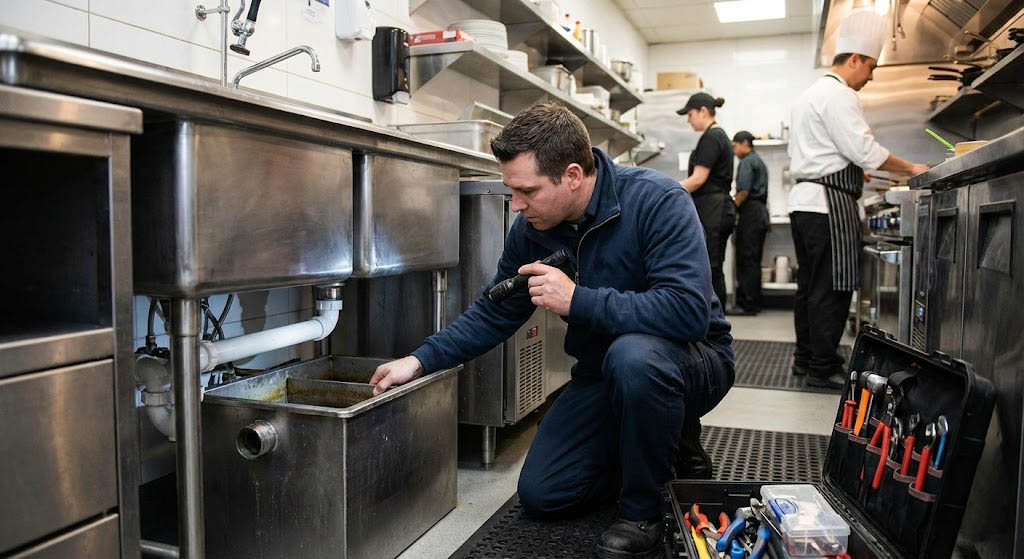
Restaurants, cafés, commercial kitchens, and food production facilities have specialized plumbing needs. Grease, fats, and oils can quickly destroy regular drainage systems if not managed correctly. That’s why grease traps (or interceptors) are required in most food-service businesses.
Essential restaurant plumbing services include grease trap sizing, installation and replacement; regular cleaning and maintenance schedules; kitchen drain cleaning and hydro-jetting to remove grease buildup; and design of high-use drain systems that can handle dishwashing, prep sinks, and floor drains under heavy demand.
Ignoring grease management doesn’t just cause slow drains—it can lead to complete blockages, sewage backups, foul odours in dining areas, and fines for non-compliance with local regulations.
6. Washroom and Fixture Installations
Customer and staff washrooms are critical for any commercial space. Functional, clean, and modern washrooms improve customer experience and employee comfort; neglected or unreliable washrooms do the opposite.
Commercial plumbers handle installation and repair of toilets and urinals suitable for high-traffic use, sensor-operated faucets and flush valves, ADA-compliant fixtures and layouts where applicable, commercial-grade sinks, utility sinks, and mop basins, and baby change-table-associated plumbing where required.
When toilets run constantly, flush poorly, or leak, professional toilet repairs ensure long-term reliability rather than repeated quick fixes.
7. Tenant Fit-Ups and Renovations
When businesses move into new spaces or renovate existing ones, plumbing often needs reconfiguration. This might mean relocating washrooms, adding staff showers, building commercial kitchens, or modifying plumbing for healthcare equipment.
Commercial plumbers work with general contractors, designers, and building managers to plan and execute plumbing for tenant build-outs—ensuring code compliance, proper pipe sizing, venting, and future maintenance access. They also coordinate inspections and approvals with city authorities.
8. Preventive Maintenance Programs
Reactive “fix it when it breaks” plumbing is expensive and disruptive for commercial properties. Preventive maintenance, by contrast, is predictable, scheduled, and far more cost-effective over time.
Typical maintenance programs include scheduled drain cleaning for high-use lines, periodic camera inspections of main drains, regular water heater service and efficiency checks, inspection of visible piping for corrosion or leaks, testing and servicing of backflow prevention devices, and seasonal checks (pre-winter and pre-spring-thaw) for freeze and flooding risks.
Montreal Plumbing offers customized maintenance programs for commercial clients, tailored to building type, usage, and risk profile.
Industry-Specific Commercial Plumbing Needs
Restaurants, Cafés and Bars
Food-service businesses rely heavily on plumbing for everything from food prep to dishwashing and sanitation. Key needs include high-capacity hot water systems, grease trap installation and cleaning, frequent drain and floor drain cleaning, bar sink installations, and emergency backup for sewer or kitchen drain issues.
A single sewer backup or kitchen drain failure during service can shut down operations. That’s why many restaurants schedule regular hydro-jetting and drain cleaning as part of their operating plan—not just in response to clogs.
Offices and Corporate Buildings
Office plumbing focuses on washrooms, kitchenettes, water coolers, and sometimes showers or fitness facilities. While usage is more predictable than restaurants, office buildings must handle peak traffic (e.g., breaks and lunchtime) without failures.
Services often include washroom fixture upgrades, water-efficient retrofits, leak detection to prevent damage in finished spaces, support for renovation projects (adding kitchenettes or staff showers), and investigation of recurring odours or gurgling that may signal deeper drain issues.
Retail and Shopping Centres
Retail environments must provide reliable washrooms (for staff and often for customers), break-room plumbing, and sometimes specialty equipment (salons, spas, pet stores). In malls and shopping centres, shared plumbing systems mean one tenant’s misuse can affect others.
Maintenance here focuses on keeping shared drain lines clear, responding quickly to washroom issues that affect customer perception, and coordinating with building management to address common-area plumbing problems.
Industrial and Warehouse Facilities
Industrial properties often have specialized plumbing needs such as large-diameter drains, chemical or process wastewater handling, emergency eyewash and safety showers, and heavy-duty hose bibs and wash-down stations.
These systems demand careful material selection (corrosion resistance), proper backflow protection, and design that can handle high flow volumes without failure. Commercial plumbers work closely with engineers and facility managers to ensure systems are safe and compliant.
Multi-Unit Residential Buildings
Duplexes, triplexes, apartment buildings, and condo towers present unique challenges: vertical stacks serving many units, shared main drains, and the need to minimize disruption to tenants during repairs. Small issues (like one tenant flushing inappropriate items) can quickly impact multiple units.
Key services include stack and main drain cleaning, camera inspection for recurring blockages, clogged drain repairs in individual units, water heater or boiler maintenance for domestic hot water, and updating aging piping systems.
Choosing the Right Commercial Plumber in Montreal
Licensing, Certification and Insurance
For commercial work, always verify that your plumber is fully licensed, holds appropriate Quebec and Montreal credentials, and carries liability insurance suitable for commercial projects. This protects your business from code violations, unsafe work, and liability for accidents.
Montreal Plumbing’s commercial team consists of licensed, insured professionals experienced in both residential and commercial systems, including complex buildings and high-demand facilities.
Proven Commercial Experience
Not all plumbers who are excellent with homes have the experience needed for restaurants, office towers, or industrial facilities. Look for a provider with documented experience across multiple commercial sectors, references or case studies from business clients, familiarity with local inspectors and permitting processes, and the ability to coordinate with property managers, GCs, and other trades.
24/7 Availability and Response Time
For businesses, availability matters as much as technical skill. Ask potential plumbing partners about their emergency response capabilities, typical response times for central Montreal and surrounding areas, how they prioritize commercial emergencies, and whether they offer service-level agreements (SLAs) for key clients.
Montreal Plumbing offers 24/7 emergency plumbing service for commercial clients, with priority response for active leaks, sewage backups, and major operational disruptions.
Capacity for Larger and Ongoing Work
Commercial plumbing often involves larger projects (full washroom renovations, system upgrades, re-piping, etc.) and ongoing maintenance. Ensure your plumbing partner has enough technicians and resources to handle both urgent repairs and planned projects without excessive delays.
Transparent Pricing and Detailed Quotes
For businesses, budgeting and cost control are critical. Look for clear, detailed quotes that break down labour, materials, permits, and any after-hours charges; consistent hourly or project-based rates; and explanations of options (for example, repair vs replacement, different material grades).
Montreal Plumbing provides transparent, itemized pricing and can prepare quotes aligned with your internal approval processes.
Preventive Maintenance vs Emergency-Only: The Business Case
The Cost of Waiting for Failure
Many businesses delay plumbing work until something breaks. While this might seem like a way to save money upfront, it nearly always costs more long-term. Emergency service usually happens at premium rates, failures cause business interruption and potential lost revenue, and damage (like water intrusion or sewage contamination) can far exceed the cost of prevention.
For example, regular hydro-jetting and camera inspection of a restaurant’s main drain might cost a few hundred dollars per year, while a full sewage backup during service can cost thousands in cleanup, lost revenue, and reputation damage.
Benefits of Planned Maintenance
Preventive maintenance gives you predictable costs, fewer emergencies, extended lifespan for water heaters and piping, better compliance with inspections and insurance requirements, and happier tenants, customers, and staff.
Montreal Plumbing can set up custom maintenance schedules for your business—quarterly, bi-annually, or annually—focused on the specific risk points in your building.
Frequently Asked Questions About Commercial Plumbing in Montreal
Do I need a different plumber for commercial work?
Ideally, yes. While some plumbers do both, commercial systems are more complex, and the consequences of mistakes or delays are higher. A plumber with specific commercial experience understands code, capacity, and operational realities of business environments.
How often should a business schedule drain cleaning?
It depends on your industry. Restaurants may need monthly or quarterly drain cleaning, offices and retail might need annual service, and multi-unit buildings fall somewhere in between. A site visit and initial inspection can establish the right schedule.
Can you work outside business hours to avoid disrupting customers?
Commercial plumbers like Montreal Plumbing routinely schedule work during evenings, early mornings, or weekends to minimize disruption. For many jobs, this is part of the planning process and can be built into the quote.
What if my building has old plumbing—do I need to replace everything?
Not necessarily. A detailed inspection can identify the most critical weak points—like failing stacks, corroded sections, or problematic drains—and prioritize staged upgrades. This allows you to spread costs over time while reducing risk.
Do you offer maintenance contracts for commercial clients?
Yes. Maintenance agreements can include regular drain cleaning, water heater service, inspection visits, and priority emergency response. They can be customized to your building type, usage level, and budget.
Commercial Plumbing Services for Montreal Businesses
From emergency repairs to long-term maintenance programs, Montreal Plumbing supports businesses across the island and surrounding areas. Our commercial services include 24/7 emergency repairs for leaks, bursts, and backups; drain cleaning, hydro-jetting, and sewer line services; commercial water heater and hot water system installation and repair; backflow prevention installation and testing; grease trap installation, cleaning, and kitchen drain maintenance; washroom and fixture installation and upgrades; plumbing for tenant improvements and renovations; and customized preventive maintenance programs.
If you own, manage, or operate a business in Montreal and want reliable, professional, and responsive commercial plumbing support, we’re ready to help.
Montreal Commercial Plumbing Specialists
Protect your business with expert commercial plumbing service—emergency response, maintenance programs, and professional installations tailored to your building.
Call Now: 514-316-9154
Note: All prices mentioned in this article are provided for general reference and informational purposes only. These prices are not fixed and may vary depending on facts, market conditions, location, time, availability, or other relevant factors. Actual prices may change without prior notice. Readers are advised to verify details independently before making any decisions.